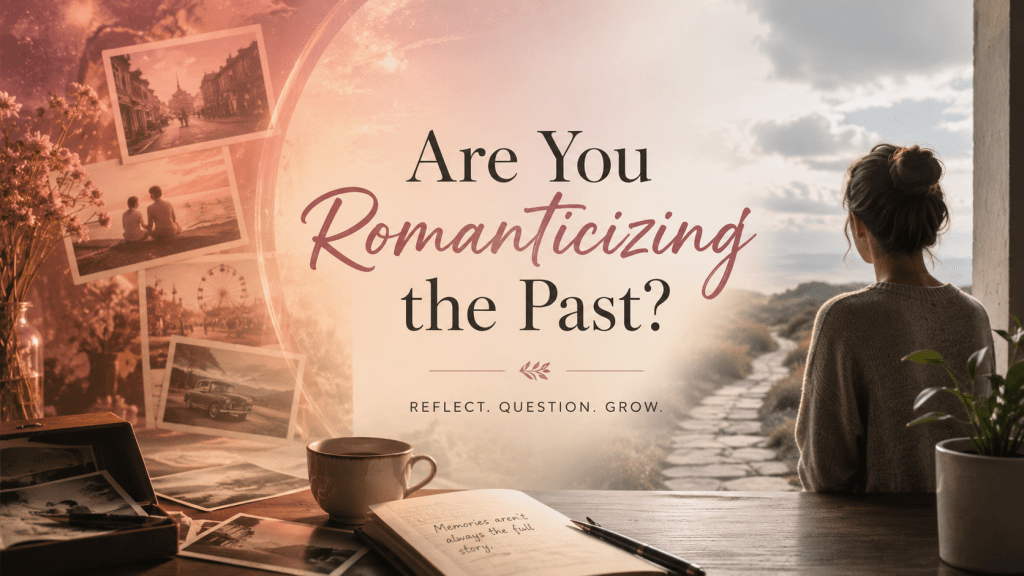
Have you ever found yourself thinking:
- “Things were so much better back then.”
- “I was happier before.”
- “I wish I could go back to how things used to be.”
If so, you’re not alone.
As a trauma-focused clinician, I often work with individuals who find themselves longing for a previous chapter of life. While nostalgia can be healthy and comforting, there is an important difference between appreciating the past and romanticizing it.
What Does It Mean to Romanticize the Past?
Romanticizing the past occurs when we remember only the highlights of a previous experience while minimizing, overlooking, or completely forgetting the challenges that existed during that time.
Our brains are naturally selective. When we feel overwhelmed, stressed, uncertain, or dissatisfied in the present, it can be tempting to look backward through a lens that softens the difficult parts and magnifies the positive ones.
Suddenly:
- The relationship that caused chronic anxiety becomes “the one that got away.”
- The job that left you burned out becomes “the best job you ever had.”
- The childhood filled with challenges becomes remembered only through holiday traditions and family gatherings.
This doesn’t mean you’re being dishonest. It means you’re human.
Why Trauma Survivors Are More Likely to Romanticize the Past
For individuals who have experienced trauma, the desire to return to the past often has less to do with the actual circumstances and more to do with a longing for safety, predictability, and control.
Trauma can disrupt our sense of stability. When life feels uncertain, our minds naturally search for moments that felt familiar or secure.
The challenge is that trauma can distort memory in two different ways:
- We may become stuck reliving painful experiences.
- We may idealize certain periods of life as a way to escape present discomfort.
Neither response allows us to fully engage with reality.
Signs You May Be Romanticizing the Past
Consider the following questions:
1. Are you remembering the highlights but not the hardships?
Every season of life contains both joy and struggle.
If you only remember the good moments, ask yourself:
“What challenges was I facing during that time?”
2. Are you comparing your worst moments today to your best moments from the past?
This is one of the most common cognitive traps.
You may be comparing:
- Today’s stress
- Today’s uncertainty
- Today’s responsibilities
to
- Yesterday’s vacation
- Yesterday’s accomplishments
- Yesterday’s happiest memories
That’s not an equal comparison.
3. Are you avoiding something in the present?
Sometimes nostalgia becomes a distraction.
Ask yourself:
“What current feeling am I trying not to experience?”
Loneliness? Grief? Fear? Burnout? Disappointment?
The answer may provide valuable insight.
4. Are you longing for a feeling rather than a specific time?
Many people believe they want to return to a certain year, relationship, or life stage.
In reality, they often miss:
- Feeling connected
- Feeling hopeful
- Feeling confident
- Feeling safe
- Feeling free
The feeling, not the actual circumstance, is what they are seeking.
The Trauma-Informed Perspective
A trauma-informed approach encourages us to hold two truths at the same time:
The past may have contained meaningful experiences worth honoring.
The past was not perfect, and neither is the present.
Healing is not about moving backward.
Healing is about integrating the lessons, strengths, and resilience developed through previous experiences while remaining grounded in the reality of today.
A Reflection Exercise
Take a moment and answer these questions:
- What specific period of my life am I missing?
- What challenges existed during that time?
- What emotions am I associating with that memory?
- What needs do those emotions reveal?
- How can I meet those needs in my current life?
You may discover that what you’re truly searching for is not a return to the past but, an opportunity to create more of what mattered most in the present.
Moving Forward
Nostalgia can be a beautiful reminder of where we’ve been. It can help us reconnect with meaningful relationships, treasured memories, and personal growth.
However, when we begin viewing the past as perfect, we risk overlooking the possibilities available to us today.
The goal is not to erase the past or ignore it.
The goal is to remember it accurately, honor it compassionately, and continue building a life that feels meaningful in the present.
Because sometimes what we’re really missing isn’t the past itself but, the version of ourselves we felt connected to during that time.
And the good news is that version of you may still be available, waiting to be rediscovered right here, right now.

